The Churn blog
Playbooks, metrics, and guides on reducing churn and keeping more of the customers you worked hard to win.

Mobile App Retention: The Playbook for Keeping Users Past Day 30
Mobile app retention works through three sequential tactics, fast onboarding, habit-forming engagement, and a save offer at the cancel or uninstall moment, the last of which most retention guides skip even though annual subscribers who cancel reactivate at only 7%.
Published August 6, 2026

How to Reduce App Uninstalls: Catch Users Before They Delete
App uninstall rate is the share of installs removed inside a fixed tracking window, averaging 46% within 30 days across all categories, and treating the uninstall like an interceptable cancel event is the tactic that cuts it.
Published August 6, 2026


Offer Acceptance Rate in SaaS Cancel Flows: Definition, Formula, Benchmarks, and How to Improve It
Offer acceptance rate measures how often cancelling subscribers accept one specific retention offer (offers accepted divided by offers shown), and reading it per offer type instead of as a blended save-rate number is what surfaces which lever, pause, discount, downgrade, or extension, is actually broken.
Published August 6, 2026

Usage-Based Pricing and Churn: What Happens to Retention When Revenue Is Metered
Usage-based pricing hides revenue loss instead of preventing it, since a customer can drop usage 80%+ and stay "retained" on a logo-churn count, so tracking usage trend, revenue churn rate, and contraction MRR together catches the loss weeks before it shows up in MRR.
Published August 6, 2026

App Stickiness: How to Build a Product Users Come Back To
App stickiness, the DAU/MAU ratio measuring how often active users return out of habit, predicts churn weeks before the cancel screen and is best improved by finding the one early "Return Trigger" behavior that separates habitual users from those who drift away.
Published August 5, 2026

What Is a Good App Churn Rate? Benchmarks by Category
App churn rate benchmarks vary sharply by category (roughly 4-5% monthly for fintech versus 8-10%+ for gaming and social) and by billing frequency, with a meaningful share of cancellations being involuntary billing failures rather than true churn.
Published August 5, 2026




How to Beat Subscription Fatigue Without Losing Customers
Fatigue-driven cancellers are cutting subscriptions on principle rather than dissatisfaction, so they respond better to a pause-first, then right-size, then discount-last save sequence than to the standard onboarding or discount playbook.
Published August 5, 2026

The State of Subscription Fatigue & Churn 2026
Median monthly subscription churn runs about 3.3%, but the useful number splits sharply by segment (0.5% enterprise annual to 5%+ consumer monthly), billing model, and voluntary-versus-involuntary cause, backed by five real cancel-flow case studies showing where save offers do and don't move the needle.
Published August 5, 2026

Time to Value in SaaS: Why It's the Earliest Churn Signal
Time to value (TTV) measures the gap between signup and a customer's first real product outcome, the earliest predictor of churn, and this post covers how to measure it, current benchmarks, and the four levers that shorten it.
Published August 5, 2026

SaaS Onboarding KPIs: The Metrics That Predict Churn
The four SaaS onboarding KPIs that predict churn (completion rate, time-to-value, activation rate, 30-day cohort retention) come with healthy-range benchmarks and a three-step system for wiring each threshold to a retention action.
Published August 5, 2026

Downgrade vs Cancel: When to Offer a Downgrade Instead of Losing the Customer
Downgrade vs cancel is the cancel-flow decision of offering a subscriber a smaller, cheaper plan instead of losing them, and it wins over a discount or pause specifically when the cancel reason is feature underuse or a price objection.
Published August 4, 2026


Grandfathering SaaS Pricing: A Retention Framework
Grandfathering existing customers at their old price avoids near-term churn but grows a widening revenue gap over time, and this framework covers how long to hold a legacy rate, how broadly to scope it, and when to sunset it.
Published August 4, 2026

Pricing and Retention: Why Every Pricing Decision Is a Churn Decision
Every pricing decision, a price increase, grandfathering, billing cadence, or a downgrade offer, either compounds retention or compounds churn, and this pillar routes each to its own data-backed article via the Virtuous and Vicious Price Cycle framework.
Published August 4, 2026

SaaS Onboarding Emails: The Sequence Built to Stop Early Churn
SaaS onboarding email sequences typically stop at activation, leaving the highest-churn-risk moment uncovered; the Activation-to-Retention Email Arc adds a re-engagement branch for stalled users and a post-activation nurture arm to close that gap.
Published August 4, 2026


Product Adoption: What It Measures and How to Raise It
Product adoption measures the share of customers reaching ongoing use of a product's core feature, distinct from user adoption (seat-level) and activation (first-value moment), with friction removal, in-moment prompts, and stall follow-up as the levers that raise it.
Published August 4, 2026


SaaS Customer Engagement: Why It Predicts Churn
SaaS customer engagement measures how often and deeply a customer uses core features, and a drop in it predicts cancellation weeks before it happens, with the four-stage Engagement Habit Loop (Adopt, Repeat, Decay, Intervene) showing how to catch and act on that drop.
Published August 4, 2026
What Is Passive Churn? How Silent Payment Failures Differ from Involuntary Churn
Passive churn is subscription loss from silent payment failures like expired cards and bank declines, distinct from active involuntary churn (disputes, bank closures), and it's best recovered in a three-stage sequence: account updater, smart retry, then dunning.
Published August 3, 2026
What Is Pre-Dunning? The 3-Stage Timeline for Stopping Involuntary Churn Before It Starts
Pre-dunning is a three-stage sequence (expiring-card email, in-app nudge, account-updater confirmation) that prevents payment failures before they happen, distinct from dunning, which recovers revenue after a charge already fails.
Published August 3, 2026
Revenue Recovery for SaaS: The Full Stack From Failed Payments to Churned Customers
Revenue recovery for SaaS is the three-layer system (failed-payment recovery, cancel-flow saves, subscriber winback) for reclaiming lost or at-risk MRR, each layer needing a different tool because subscribers are in a different state at each moment.
Published August 3, 2026

Smart Retry Logic for Failed Payments: How to Time Your Dunning Retries to Maximize Recovery
Smart retry times payment retries by decline code, billing cadence, and payment method rather than a fixed schedule, recovering 40-50% of soft-decline failures within the first two attempts per Churn.io's retry sequencer data.
Published August 3, 2026
Stripe Dunning: How Stripe's Built-In Retry Logic Works (and Where It Falls Short)
Stripe dunning combines Smart Retries, payment-failure emails, and a hosted card-update page to recover failed subscription payments, but three settings (retry window, subscription end-state, account updater enrollment) decide how much of that recovery you actually capture.
Published August 3, 2026


Customer Winback: SaaS Glossary Definition
Customer winback is the process of re-engaging customers who cancelled by choice, the third stage of the SaaS retention sequence after the cancel flow and dunning, and it's worth running only when reactivation cost beats new-customer acquisition cost.
Published August 3, 2026

Winback Email Subject Lines by Reason and Sequence Position
Winback email subject lines that get opened match two variables: why the customer cancelled (price, feature-gap, silent churner) and how far along the sequence they are (first touch, second touch, last-chance sunset).
Published August 3, 2026

Win Back Email Examples and Templates by Cancel Reason
Three copy-ready winback email templates for price-objection, feature-gap, and low-usage cancellations, each opening with a different move matched to the reason the customer left, sequenced across a three-touch cadence at day 1-14, 30, and 60-90.
Published August 3, 2026

Network Tokenization for SaaS: What It Is, How to Enable It, and How Much Involuntary Churn It Cuts
Network tokenization replaces a stored card number with a network-issued token that stays automatically mapped to the live card, cutting authorization failures on recurring charges by roughly 2 to 5 points when run alongside account updater.
Published July 30, 2026

Mobile App Involuntary Churn: Why Google Play Loses More Subscribers to Billing Errors Than the App Store
Google Play billing errors cause more than double the involuntary-cancellation rate of the App Store (32.3% vs. 15.2%), and turning on each platform's native grace period plus in-app and push messaging recovers most of the gap.
Published July 30, 2026

Involuntary Churn Rate: What It Is, How to Calculate It, and What Causes It
Involuntary churn rate is the share of active subscribers lost to unrecovered payment failures each period, calculated by dividing lost-to-failure subscribers by active subscribers at period start, with a median of about 0.86% monthly across subscription businesses.
Published July 30, 2026

Hard Decline vs. Soft Decline: The SaaS Dunning Decision Tree
A soft decline (insufficient funds, timeout, velocity limit) is worth retrying on a spaced schedule, while a hard decline (stolen card, closed account, fraud flag) should go straight to a card-update request since retrying it only adds fees and dispute risk.
Published July 30, 2026

What Is Involuntary Churn? (SaaS Glossary)
Involuntary churn is customer loss caused by payment failures rather than a customer's decision to cancel, accounts for roughly a quarter of total monthly churn, and is mostly recoverable once you route each failure (card expiry, soft decline, hard decline) to the right fix.
Published July 30, 2026


Dunning management software: how to choose the right failed-payment recovery tool
Native billing-platform dunning (Stripe, Chargebee, Recurly) handles retry timing but can't A/B test emails, capture churn reasons, or segment ROI, so the 5-Question Audit tells you when a dedicated recovery tool is worth paying for.
Published July 30, 2026


Card Decline Codes: The SaaS Operator's Retry and Dunning Guide
Card decline codes tell you whether a failed payment is worth retrying, and routing each one by its Visa category or Mastercard advice code turns roughly 60 to 70% of declines into recoverable revenue instead of involuntary churn.
Published July 28, 2026

Annual Billing and Involuntary Churn: How Annual Plans Eliminate Most Payment Failure Risk
Annual billing collapses twelve yearly payment attempts into one, cutting involuntary churn from the 7-14% monthly-subscriber range to 0.5-1%, and the three-stage playbook here covers how to identify upgrade candidates, time the offer, and measure the churn delta by cohort.
Published July 28, 2026

What Is Account Updater? How Card Networks Reduce Involuntary Churn Before It Starts
Account updater (CAU) is a card-network service that refreshes stored card credentials before a charge can fail, and it sits as layer one of the four-layer involuntary churn stack ahead of smart retry, dunning, and chargeback mitigation.
Published July 28, 2026

SaaS Retention Benchmarks (2026): Logo Retention, GRR, NRR, and Churn Rate by ARR Stage
Logo retention, GRR, NRR, and churn rate benchmarks segmented by ARR stage, so a company at $1-5M ARR targets 78-80% logo retention while one at $15-30M targets 84%+ instead of a single flat tier.
Published July 28, 2026


What Is Expansion Revenue? (SaaS Glossary)
Expansion revenue is additional revenue from customers who are already paying, earned through upsells, cross-sells, or seat and usage increases, and it is the only positive input in the NRR formula, making up 40% of new ARR at the median SaaS company.
Published July 28, 2026
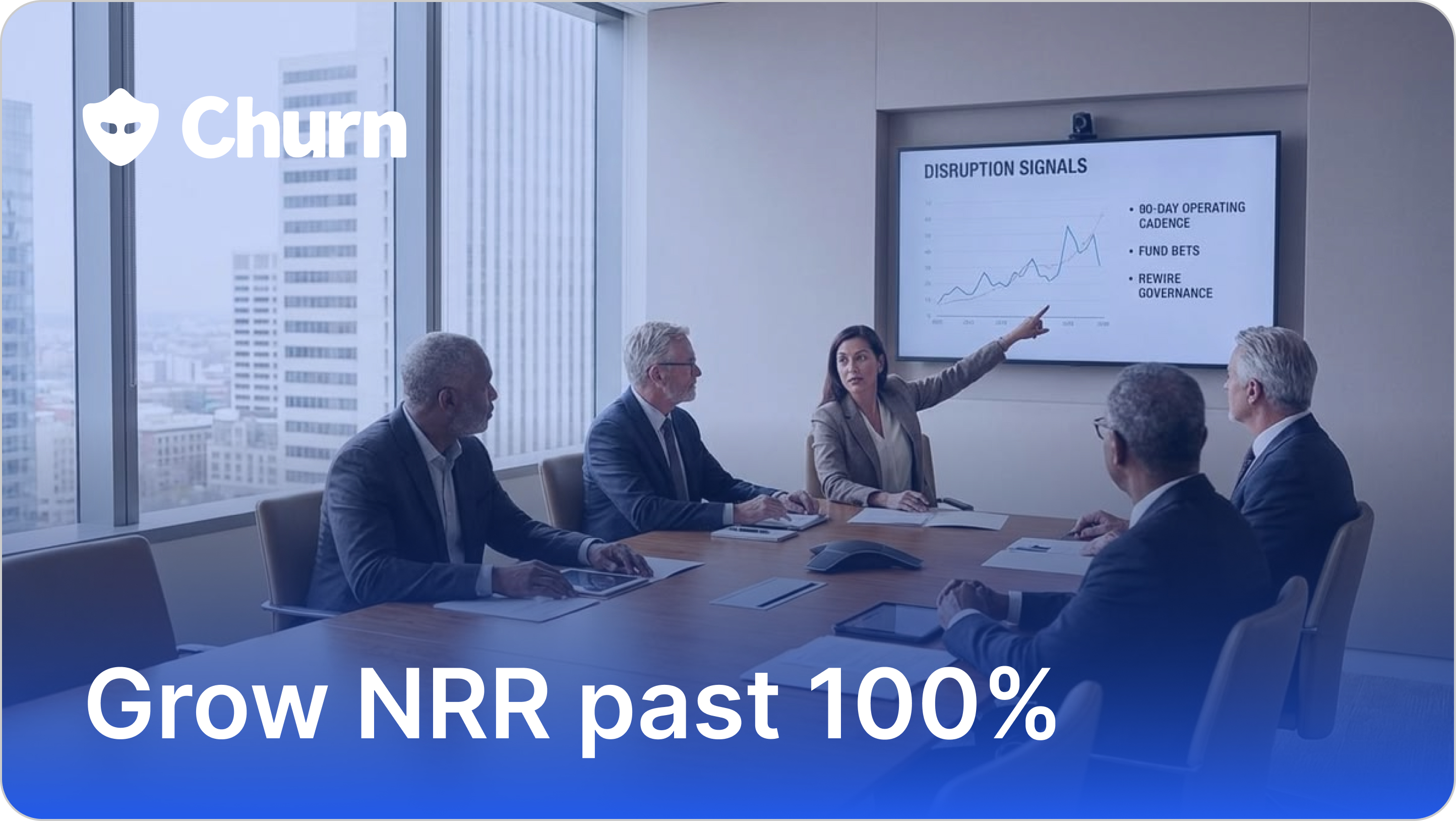
The Expansion-Revenue Playbook: How to Grow NRR Past 100%
Upsell, cross-sell, and seat or usage expansion are the three moves that push NRR past 100%, each fired by its own product signal, and sizing them against the gross-revenue-retention gap (1 − GRR) tells you how much expansion you actually need.
Published July 28, 2026


Gross Revenue Retention (GRR): The Metric You Defend, Not Just Measure
Gross revenue retention (GRR) measures the percentage of recurring revenue kept from existing customers after cancellations and downgrades, excluding expansion, capping it at 100% and revealing base-level churn that a healthy NRR can hide.
Published July 24, 2026

Gross vs Net Revenue Retention: What Each Number Is Telling You
Gross revenue retention caps at 100% and measures the churn floor, while net revenue retention adds expansion revenue back in and can exceed it, so tracking both reveals whether a healthy NRR is masking a declining GRR.
Published July 24, 2026

Customer Health Score: How to Calculate It and What to Do When It Drops
A customer health score rolls product usage, support, sentiment, and billing signals into one weighted 0-100 number using the four-step 100-Point Scorecard, with bands calibrated against your own churned accounts driving the specific action each score triggers.
Published July 22, 2026

Upsell vs Cross-Sell for SaaS: Which Expansion Motion to Use, and When
Upsell moves a customer to a bigger version of what they already pay for while cross-sell adds a separate product, and the Expansion Motion Matrix in this post maps each subscriber lifecycle stage (newly activated, mature, at-risk) to the right one.
Published July 22, 2026

What Is Net Revenue Retention (NRR)? (SaaS Glossary)
Net revenue retention (NRR) measures the percentage of recurring revenue kept from an existing customer cohort after expansion, contraction, and churn, with the formula, GRR comparison, and stage-based benchmarks (94% at $1-3M ARR up to 120%+ for top public SaaS) laid out for quick reference.
Published July 22, 2026


The Complete Guide to Cancel Flows for Subscription Businesses
A structured cancel flow intercepts voluntary cancellations to capture the reason and match a retention offer before the customer leaves, and Churn.io data shows matched offers save 15-34% of would-be cancellations versus far weaker results from blanket discounts.
Published July 22, 2026
Subscription Cancellation Law in 2026: What the Click-to-Cancel Rule Means for SaaS Now
Federal click-to-cancel enforcement collapsed in 2025, leaving ROSCA and state auto-renewal laws in California, New York, and Colorado as the active requirements, and a five-item Compliant Cancel Path checklist satisfies all of them at once.
Published July 22, 2026

Churn Prevention Software: The Buyer's Guide for Subscription Businesses
Churn prevention software splits into active-intervention tools (cancel flow, dunning) and passive monitoring tools (customer success platforms), and the buyer's real first step is diagnosing whether voluntary or involuntary churn is the larger share of their losses before picking a category.
Published July 22, 2026




Exit Survey Questions for Cancellations: The SaaS Question Bank
A SaaS cancellation exit-survey question bank organized by the five cancel reasons (price, product-fit, low usage, competitor switch, involuntary), with each question written in the customer's own words so its answer routes to a matched cancel-flow offer.
Published July 20, 2026

Cancel Flow vs. Dunning: Two Tools, Two Churn Problems
A cancel flow and dunning solve two different churn problems: a cancel flow logs the reason and shows a save offer to subscribers who choose to leave (voluntary churn), while dunning uses smart retries and reminder emails to recover failed payments (involuntary churn).
Published July 20, 2026

Churn Reasons Analysis: How to Diagnose Your Specific Reason Mix
Churn reasons analysis is a diagnostic method that classifies each stated cancellation reason into one of five buckets (Price-Signal, Low-Activation, Low-Engagement, Competitive-Switch, Structural Exit) and weights them by MRR impact rather than raw count.
Published July 20, 2026

What is Offer Acceptance Rate in SaaS Cancel Flows?
Offer acceptance rate is the share of cancelling subscribers who accept a specific retention offer (pause, discount, downgrade, or free extension) inside a cancel flow, measured per offer type rather than as a single blended flow number.
Published July 20, 2026
Cancel Flow Best Practices for B2B SaaS: 10 Practices That Raise Save Rate
Ten cancel flow best practices for B2B SaaS operators, built around a four-step sequence: collect the cancel reason before showing any offer, match the offer type to the reason rather than the plan tier, keep cancellation as easy as sign-up, and route saves into a post-save follow-up.
Published July 20, 2026
Customer Winback: What It Is, When to Use It, and Whether It Pays Off
Customer winback is stage 3 of the SaaS retention sequence, re-engaging customers who voluntarily cancelled after the cancel flow and dunning have run. This post covers who qualifies, how to segment lapsed customers by cancel reason, and the reactivation-CAC-vs-acquisition-CAC math that decides whether a campaign pays off.
Published July 20, 2026
What Is a Cancellation Flow?
A cancellation flow is the four-step sequence (intent detection, exit survey, retention offer, confirmation or save) a subscriber sees when trying to cancel. Covers how it differs from dunning and offboarding, and the two metrics (save rate, offer acceptance rate) used to measure it.
Published July 16, 2026

What Is Dunning?
Dunning is the automated process that recovers failed subscription card payments through retries and escalating communication before suspending access. Covers the four-stage process (detection, retry, communication, suspension), how it differs by billing frequency, and how it's distinct from collections.
Published July 16, 2026




What is Voluntary Churn?
Voluntary churn is when a customer actively decides to cancel, distinct from involuntary churn caused by a payment failure, and accounts for 60-80% of total churn at most subscription businesses. Covers the voluntary vs. involuntary distinction, what churn timing reveals about root cause, and the three interventions that reduce it.
Published July 16, 2026


What is Lifetime Gross Profit?
LTGP (lifetime gross profit) is the gross-profit version of LTV, subtracting COGS before multiplying by customer lifespan, and typically runs 20-40% below LTV. Covers the formula, a worked example, and the LTGP:CAC ratio target by business model (3:1 to 9:1 based on human touchpoints).
Published July 16, 2026

What is Cohort Retention?
Cohort retention tracks the percentage of customers from a specific signup month still paying over time, revealing onboarding and product-value problems that aggregate churn rate hides. Covers the formula, a worked example, three diagnostic curve shapes, and how it differs from aggregate retention.
Published July 16, 2026

What is Churn Rate?
Churn rate is the percentage of customers or revenue a subscription business loses in a given period. This glossary entry covers the formula (including the correct monthly-to-annual compounding calculation), the difference between customer churn and revenue churn, benchmark ranges by billing frequency and segment, and how to tell structural churn from operational churn. Includes a related-terms table linking to retention rate, NRR, and cohort retention.
Published July 16, 2026